The artist Liviu Alexa plays without a joker in a new "bad boy" exhibition
Curatorial.ro · 20 April 2026
"Filcăi" is the second personal exhibition of Liviu Alexa, investigative journalist who decided without asking anyone's permission to force the gates of contemporary art with the same energy with which he analyzes everyday political and social morals.
If in Cluj-Napoca, two months ago, through "We are the Apocalypse", Alexa produced a shock of debutante, in Bucharest the stake was defined differently: he no longer has to prove that he can, but that he knows where he is going. And that it has the creative force to maintain the same intelligent-informal tone of the works.
The "Filcăi" project starts from a modest and almost forgotten cultural object, a traditional card game of Transylvania, spread on the knees of commuters in train carriages, at vigils and in neighborhood bodegas.
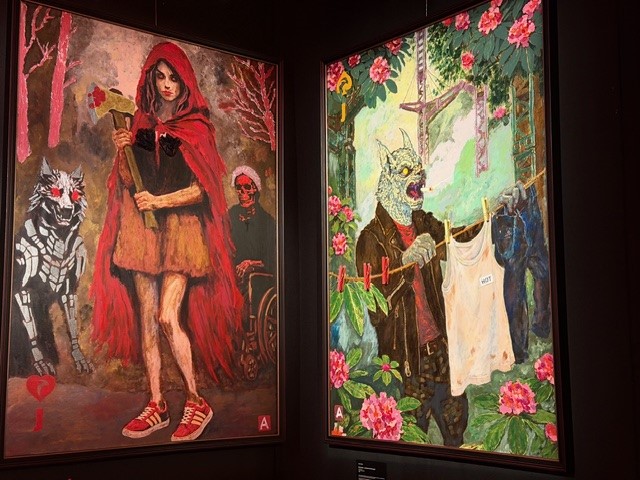
Alexa reclaims it not as an ethnographic museum artifact but as a narrative vehicle, redrawing the game's twenty cards as large canvases, each with a character reincarnated in the immediate present. The works are thought of as a pack subject to the will of fate: the cards are shuffled, dealt, played, and the result is not really controlled by anyone, not even the artist himself. Inspired by the Tarot cards drawn by Dalí in the last years of his life, Alexa chooses the more difficult path: not the rarefied mystical symbolism of the tarot, but precisely the thickness of life viewed through the window, made up of commonplace objects, domestic failures, everyday myths. The paintings each tell a story, detailed, epic, unexpected and have a sense of force. Perhaps this is the most meaningful impression of the collection made by the artist: a stylistic unity, a homogeneous expressiveness declined in twenty episodes that surprise and intrigue.
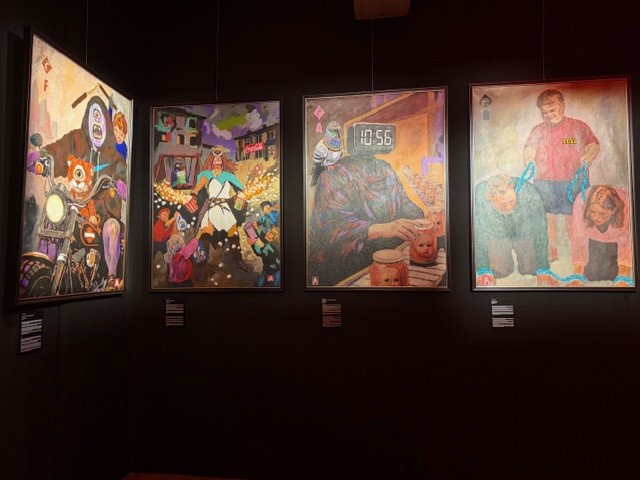
Ochilă, the wingman character of Harap Alb, appears in Alexa's canvas as a seed-eating alpha male, a Natural Born O'Killa dressed in polo shirt, sitting at the game table without opponents. His eyes are detached, like drones of (re)cognition that scan the depths "to the rabbit's shadow". Equally memorable is Caligula, reincarnated as a successful investor-guru, introducing the new CEO to the board - the same favorite horse, this time with an expensive watch and tie - while on the back wall, in an aura of sainthood, watches over a Maradona with locks, unlikely idol, but chosen by the community. Equally aggressive and uncomfortable is the canvas dedicated to the King of Parents – a fat and sarcastic child, who walks on a leash his parents resigned and confused by the unforeseen consequences of their own actions.
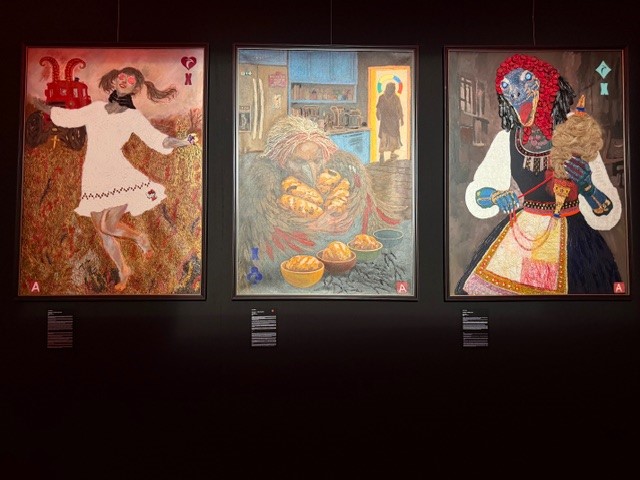
Looking more closely, Alexa's canvases are full of "unmade", as she confessed at the opening even the author. The details are hidden in plain sight, but they ask the viewer to linger, search and eventually discover. Among them sneak, with undisguised intention, a lot of recognizable brands: logos, packaging, references to digital platforms and the culture of immediate consumption. It's not decoration, it seems like a criticism of excess. Alexa builds a visual indictment against a society that lives on social media and has no time to live "for real," a society that has replaced direct experience with its commercial iconography.
Perhaps Alexa's bravest bet is that she continues to refuse the abstract as a refuge. His canvases are narrative, deliberately funny through unexpected associations and material inserts, but still uncomfortable. They are addressed to a wide audience, but without discounting the personal message. This alchemy of accessibility without simplism and dark humor without populism is precisely what is frequently missing from the Romanian contemporary art scene, too affected in some places either by the caste syndrome or by decorativism commercial.
The second exhibit confirms that the first was no accident. Liviu Alexa doesn't need some miraculous joker to "cut" the whole pot, he just needs to play his "hands" with the same consistency and freedom that begin to compose a coherent artistic program. The artist's audacity goes beyond the pace in which he organized his exhibitions (two vernissages in 3 months), quoted his works at the price of 12,000 euros each, accompanied each of his exhibitions with a very skillful marketing campaign; but also the positioning he assumes in the arena of local contemporary painting arouses controversy and, therefore, interest.
Some of the canvases are already sold, and this brings the good news that art, accompanied by talent and ideas, when augmented with sustained marketing effort, can sell at premium prices. The buyer of one of the works, a collector of recent art, told Curatorial at the time of the venisage that "this canvas is the most untold of the Little Red Riding Hood story, it is a special visual emphasis, a tough and current metaphor of how the victim can easily turn into the aggressor. Yes, it is a high price for an artist at the beginning of the road, but part of the mission of those who love contemporary art is the support they can give, there where they identify talent, vision, creativity, precisely to stimulate the growth of the local market".
The opening of "Filcăi" took place on April 16 at the Kulterra gallery in Bucharest, and the exhibition, curated by Prof. Univ. Dr. Lucian Nastasă-Kovács, can be visited until May 10, 2026.