Put on your jacket
Neuma - revistǎ de culturǎ · March 2026
by Andrea H. Hedeş
We live, whether we like it or not, consciously or not, in a world that, although chaotic, draws the squares in which it places and labels the human being. In the moment of tagging—most often through shallow tags—the individual is lost; he becomes an anonymous in a series, one element in a long line of "somes" whose personality seems never to have existed, or if it did, it didn't matter. In the language of the new generations, these are NPCs.
But what happens when, rarely, one ins appears that no longer fits into the box? A spirit that cannot be labeled and that refuses the common, familiar and thereby comforting trajectory? If this "ins" is a woman, she is regarded as a "witch of hell"; if he is a man, he is considered a scandalous madman (genius). Not only the mouth of the world, but also the brotherhoods react viscerally. But the most painful thing for others is when the outsider is successful.
It's like the parable of the world: "It is told in an old book that a father and his son went to the market to sell a donkey. They were walking by the animal, when they met some people who welcomed them: "What stupid people! They break their the shoes so as not to wear out the horseshoes of the donkey!»". You know the continuation, or you can suspect it.
On February 12, 2026, the opening of the painting exhibition "We are the Apocalypse", signed by the artist Liviu Alexa, took place. On this occasion, university prof. Dr. Lucian Nastasă-Kovács (manager of the Cluj-Napoca Art Museum), prof. Dr. Ioan Sbârciu, the visual artist Liviu Alexa, his son, Ștefan Alexa — who in turn exhibited — and the museographer Dr. Dan Breaz, as curator.
The event was a striking one, standing out not only for the element of surprise — the unexpected debut in art of the journalist and writer Liviu Alexa — or for the percussive vivacity of the exhibited canvases. The success was also ensured by the presence of a large audience (approximately 400 people), but above all by the impeccable reception strategy, carried out meticulously until the meeting with the officials of the Cluj-Napoca Art Museum.
Looking back, we notice a perfectly maintained mystery. Over the last year, Liviu Alexa has offered only discreet hints through a travelogue through important European museums, displaying impressive specialist knowledge on that occasion. Just as in literature, where quality writing calls for solid readings and a good command of literary history, art also requires a deep theoretical foundation—if only to have the freedom to break the rules or invent new ones.
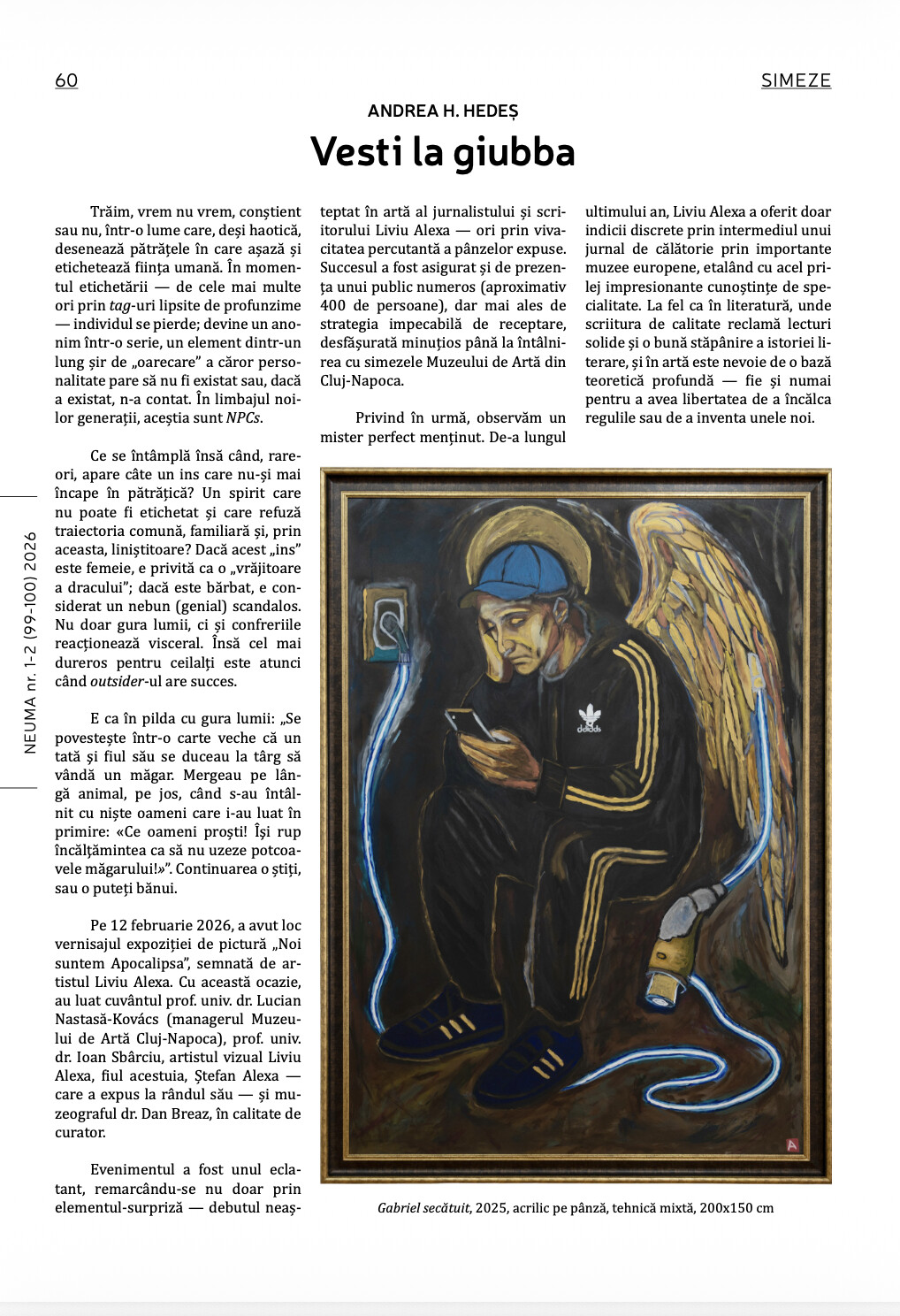
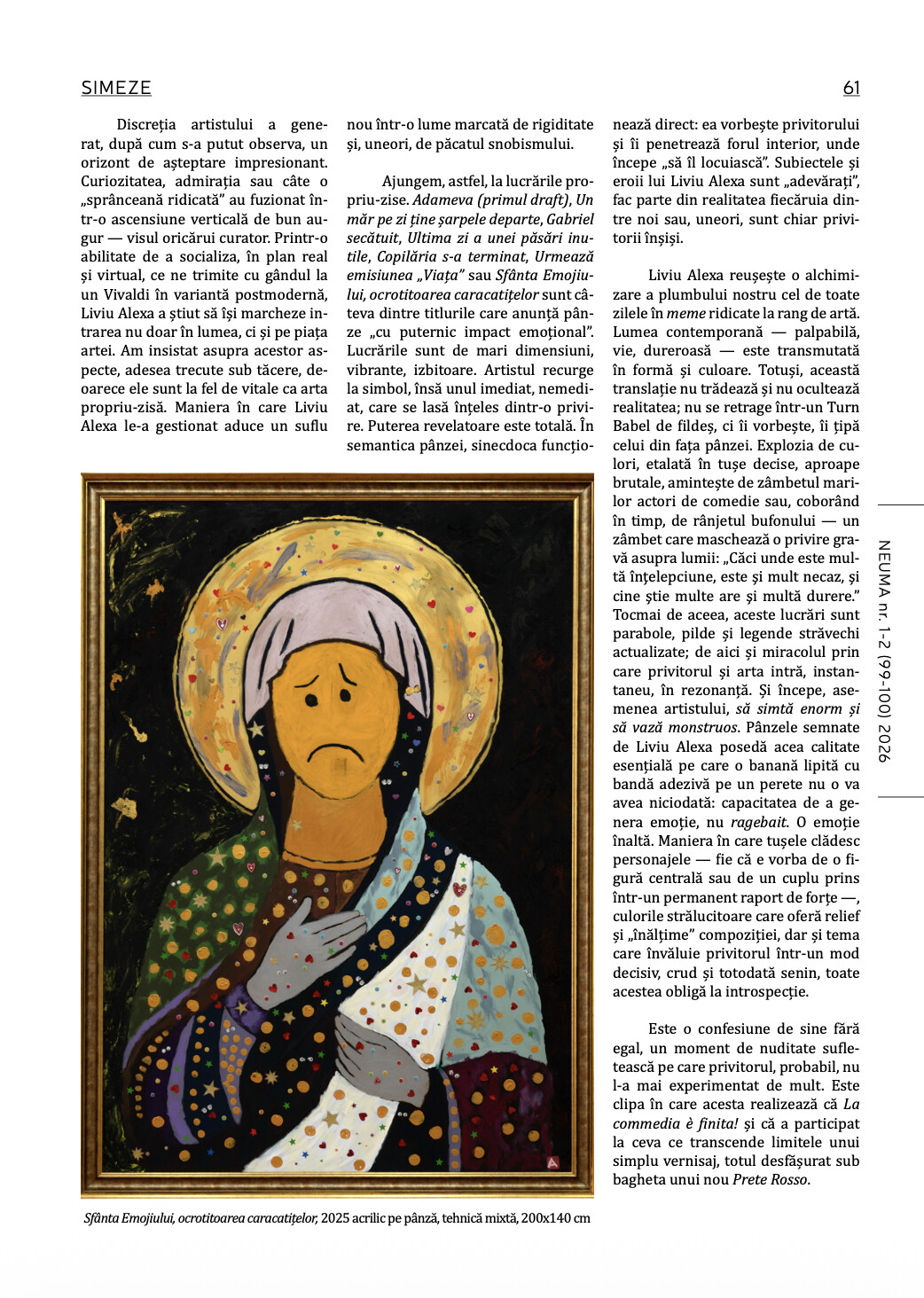
The discretion of the artist generated, as could be seen, an impressive horizon of expectation. Curiosity, admiration, or a "raised eyebrow" merged into an auspicious vertical ascent — every curator's dream. Through an ability to socialize, in real and virtual terms, what makes us think of a Vivaldi in a postmodern version, Liviu Alexa knew how to mark his entry not only into the world, but also into the art market. I have insisted on these aspects, often passed over in silence, because they are as vital as the art itself. The way in which Liviu Alexa managed them brings a new breath to a world marked by rigidity and, sometimes, by the sin of snobbery. Adameva (first draft), An apple a day keeps the snake away, Gabriel desiccated, The last day of a useless bird, Childhood is over, The show "Life" is coming or Emoji Saint, Protector of Octopuses are some of the headlines announcing canvases "with strong emotional impact". The works are large, vibrant, striking. The artist uses a symbol, but an immediate, unmediated one that can be understood at a glance. The revealing power is total. In the semantics of the canvas, synecdoche works directly: it speaks to the viewer and penetrates his inner forum, where he begins to "inhabit" him. Liviu Alexa's subjects and heroes are "real", they are part of the reality of each of us or, sometimes, they are even the viewers themselves.
Liviu Alexa manages to alchemize our everyday lead into meme raised to the level of art. The contemporary world—palpable, living, painful—is transmuted into form and color. However, this translation does not betray or conceal reality; he does not retreat into an ivory Tower of Babel, but speaks to, shouts to the one in front of the screen. The explosion of colors, displayed in decisive, almost brutal touches, reminds of the smile of the great comedians or, going down in time, the jester's grin — a smile that masks a serious view of the world: "For where there is much wisdom, there is also much trouble, and he who knows much has much pain." Precisely because of this, these works are updated parables, parables and ancient legends; hence the miracle by which the viewer and the art enter, instantly, into resonance. And he begins, like the artist, to feel enormous and to see monstrous. Liviu Alexa's canvases possess that essential quality that a banana taped to a wall will never have: the ability to generate emotion, not ragebait. A high emotion. The way in which the touches build the characters — whether it is a central figure or a couple caught in a permanent relationship of forces —, the bright colors that give relief and "height" to the composition, but also the theme that envelops the viewer in a decisive, cruel and at the same time serene way, all this forces introspection.
It is an unparalleled self-confession, a moment of soulful nudity that the viewer probably hasn't experienced in a long time. It is the moment when he realizes that La commedia è finita! and that he has participated in something that transcends the limits of a simple opening, all carried out under the baton of a new Prete Rosso.